
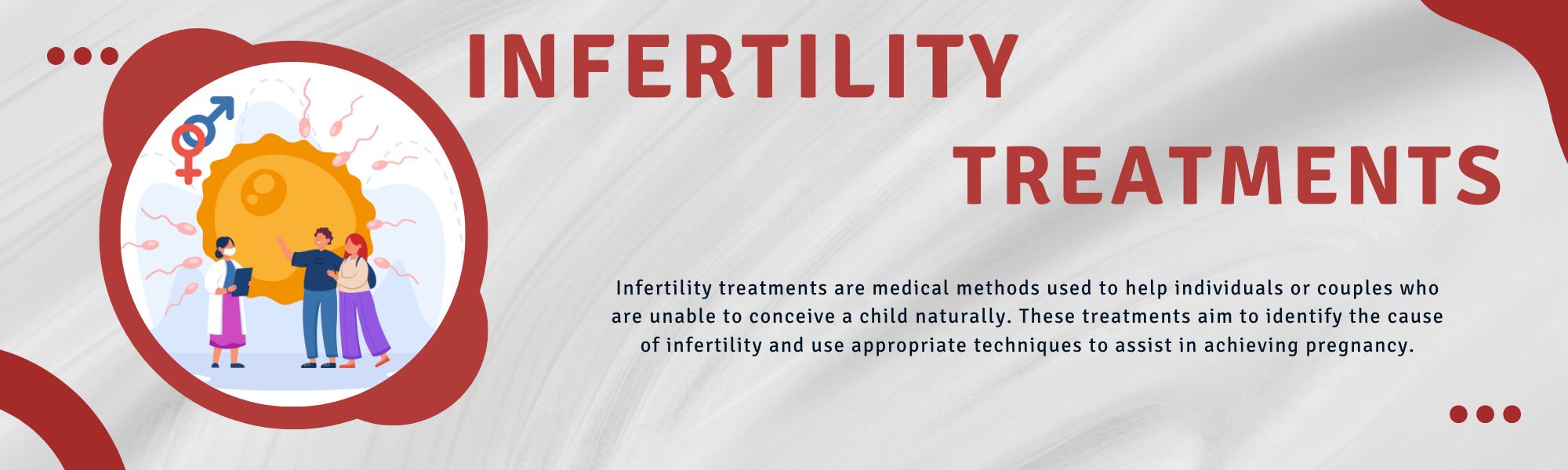
What is infertility treatment?
Infertility is a condition in which a couple is unable to conceive despite regular unprotected intercourse over the course of a year. This issue can affect both men and women. The good news is that infertility can be treated with today's modern medical sciences.
What are the causes of infertility?
Common causes of infertility in women:
1. Ovulation problem (not ovulating)
2. PCOS (Polycystic Ovary Syndrome)
3. Endometriosis
4. Due to aging, the quality of eggs decreases.
5. Closure of the fallopian tube
Common causes of infertility in men:
1. Decrease in the number of sperm.
2. Decrease in the movement of sperm.
3. Hormonal imbalance.
4. Inherited problems.
5. Lifestyle-related causes such as smoking, alcohol, stress, etc.
When should one consult a doctor for fertility treatment?
Having a child is a significant dream in the life of every couple. However, sometimes it becomes difficult to conceive naturally. In such situations, fertility treatment can become an effective solution. But the most important question is: When should one see a doctor for fertility treatment? Let's understand this in detail.
1. Despite trying for a year, not being able to conceive.
If you and your partner have been trying to conceive for a year without any form of contraception and are still unable to get pregnant, this could be the first warning sign. In such cases, it becomes important to consult a fertility specialist. For women over 35, this period is considered to be 6 months.
2. Irregularity in periods (menstruation)
Irregular periods in women can indicate a hormonal imbalance or problems with ovulation. If your period comes too early, too late, or doesn't occur at all, it could be a fertility issue.
3. Problem related to sperm in male partner
Fertility problems are also common in men. If the sperm count is low, the motility of the sperm is poor, or the quality of the semen is not good, it is necessary to consult a doctor. A sperm test can be conducted for this.
4. A history of previous abortion or unsuccessful pregnancy.
If a woman has had a premature birth or has experienced repeated miscarriages, there may be certain underlying medical reasons. In such cases, it is important to consult a doctor in a timely manner.
5. Problems such as Endometriosis or PCOD
If a woman suffers from diseases such as PCOS (Polycystic Ovary Syndrome), endometriosis, or thyroid problems, it can affect the conception process. In this case, it is possible to determine the appropriate treatment with the help of a fertility specialist.
6. Difficulty in sexual relations
If due to some reason the couple is having difficulty in having physical relations, such as erectile dysfunction or vaginal pain, it can also hinder fertility. Do not ignore it.
7. Age-related concerns
If a woman is over 35 years old, fertility gradually begins to decrease. In such a case, it would be wise to seek advice from a doctor without delay.
Conclusion
Do not ignore any fertility-related issues. It is very important to consult a fertility specialist in a timely manner to begin with the right diagnostics and treatment. In today's times, medical science has made such great strides that many couples have realized their dream of becoming parents thanks to fertility treatment.
What is the process of fertility treatment?
The accelerated lifestyle of today, increasing stress, an unbalanced diet, and many other reasons lead to many couples having difficulty becoming pregnant. In such a situation, fertility treatment (treatment of infertility) is an effective solution. However, many people wonder: How does the process of fertility treatment work? Let us explore this in detail in this article.
Fertility treatment process (Step-by-Step)
1. Preliminary examination and consultation (Initial Consultation & Testing)
First of all, the complete medical history of the couple is taken and some necessary tests are conducted:
For women:
Hormone test (FSH, LH, AMH, etc.)
Ultrasound (TVS)
Ovulation tracking
Hysterosalpingography (HSG) – Test of the fallopian tubes
For men:
Seamen Analysis
Hormonal and genetic tests (if needed)
Based on all these reports, the fertility specialist determines which type of treatment will be most suitable.
2. Types of Fertility Treatments
According to the tests and medical condition, the doctor may suggest one or more of the following procedures:
(A) Ovulation Induction
If a woman does not ovulate, the doctor can prescribe certain medications (such as clomiphene or letrozole) to induce ovulation. It is a simple, cost-effective, and basic procedure.
(B) IUI – Intrauterine Insemination
In this process, the man's sperm is cleaned and directly introduced into the woman's uterus. This allows the sperm to reach the egg directly, which increases the chances of conception.
Steps of the IUI procedure:
1. Women are given ovulation drugs.
2. A trigger injection is given when the egg is ready.
3. IUI is done 24-36 hours later.
4. A pregnancy test is done after two weeks.
(C) IVF – In Vitro Fertilization (Test Tube Baby Procedure)
This is the most famous and effective fertility treatment, especially when other measures have failed.
Stages of the IVF process:
1. Hormonal injections are given to develop the eggs (for about 10-12 days).
2. Eggs are retrieved under ultrasound guidance.
3. Sperm and eggs are mixed in the lab.
4. Once the embryo is prepared, it is transferred to the uterus.
5. A pregnancy test is done 12-14 days later.
(D) ICSI – Intracytoplasmic Sperm Injection
It is an advanced IVF technique when the number or quality of male sperm is very low. In this technique, each sperm is injected into the egg under a microscope.
(E) Other options
1. Donor Egg/Sperm – when a woman's or man's egg/sperm is not viable.
2. Surrogacy – when a woman is unable to conceive.
3. Frozen Embryo Transfer (FET) - Use of previously preserved embryos
Time required for fertility treatment
Each process has a different timeline. For example, IVF takes about 3-6 weeks. Some women may need more than one cycle.
Possibilities and success rate
Success rate of IUI: 10–20% per cycle
Success rate of IVF: 40–70% (depends on the woman's age and condition)
Conclusion
Fertility treatment is a planned and scientific process that has given the joy of parenthood to millions of couples. Timely testing, advice from an experienced fertility specialist, and decisions made with patience can help realize your dreams.
Potential risks associated with fertility treatment
As with all medical procedures, fertility treatment also carries certain risks or potential side effects. Although these do not occur in all patients, it is important to be aware of them in advance.
1. Multiple pregnancy (twins or more children)
The number of eggs in IUI or IVF can be higher, which can increase the chances of twins or even triplets. This can complicate the pregnancy and increase the risk of preterm birth.
2. Ovarian Hyperstimulation Syndrome (OHSS)
Hormone injections can sometimes cause the ovaries to overreact, leading to problems such as bloating, pain, nausea, vomiting, and water retention in the abdomen.
3. The risk of infection during egg retrieval or embryo transfer.
There can be very few cases of infections during egg retrieval or embryo transfer; however, this is extremely rare and can be prevented by antibiotics.
4. Emotional and mental stress
The long process, the hope, and the fear of failure can burden couples emotionally. Fertility counseling can be helpful during this time.
5. Failed Attempt (Treatment Failure)
There is no 100% success guarantee with any fertility treatment. Sometimes it can take 2 to 3 cycles. This can cause mental, emotional, and financial stress.
6. Congenital defect in the child (very rare)
Some studies have indicated a very slight possibility of congenital disorders in children born through IVF, but no clear solid cause has been found.
Can these risks be avoided?
Yes, the treatment conducted by an experienced fertility specialist, with the appropriate dosage and continuous monitoring, can minimize these risks. You must follow the doctor's instructions closely and report any discomfort immediately.
We believe in affordable specialty healthcare for all.
Consectetur adipiscing elit, sed do eiusmod tempor incididunt ut labore et dolore.